
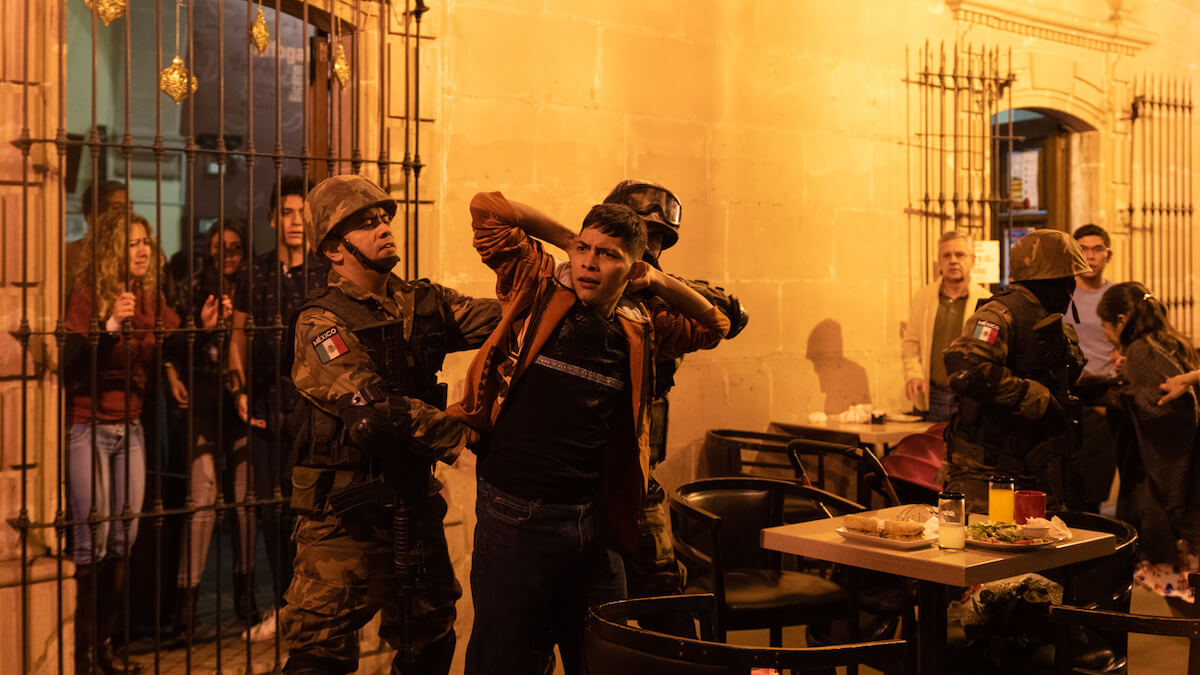
With the so-called New Wave, Romanian cinema has generated remarkable international interest in films made by Romanian directors, its consecration coming mainly from selections and awards at Cannes, the most important world film festival in the world concerning film releases. This year, the tradition was carried on by LA CIVIL, by Teodora Ana Mihai, the only Romanian film in the official selection, which received a standing ovation for eight minutes and was rewarded in the final list of the Un Certain Regard section with Courage Award.
La Civil will have its Romanian premiere on Friday, 22 October, at the opening of the 12th edition of Les Films de Cannes à Bucarest, in the presence of its director, who will introduce the film and have a discussion with the Romanian audience, after the screening. At the same time, Teodora Ana Mihai will be present on Sunday, 24 October, in Iași where she will present the film to the local public.
Teodora Ana Mihai is a Belgian director of Romanian origin, who attracted the attention of the film world with the feature-length documentary Waiting for August, which tells the story of Romanian children left to fend for themselves after their parents went to work abroad. Waiting for August has been selected and presented in over 40 festivals, receiving no less than 11 awards, including the Grand Prize for Best Documentary Film at Karlovy Vary International Film Festival.
La Civil is a Belgian-Romanian-Mexican co-production, the film being endorsed by the production houses of some well-known authors in Cannes: Les Films du Fleuve of the Dardenne Brothers, Mobra Films of Cristian Mungiu and Michel Franco’s Theorem. The film was selected in the competitions of the Cannes and Venice festivals, and following its August premiere, it was invited to 15 other international festivals.
The production took place in extremely difficult conditions, being filmed in 2020, in the midst of a pandemic, in Durango, Mexico, the director having the strength to manage the film, health conditions, and her new role as a mother.
According to Screen Daily, La Civil “paints a compelling picture of a society in which nobody can be trusted and everyone is complicit in a neverending cyle of violence“ – the story being the result of several years of extensive research undertaken by the director in collaboration with Mexican writer Habacuc Antonio de Rosario.
The film is inspired by a heartbreaking true story, a ransom in a Mexican society where clans are above law and authorities. Starting from the real case, in La Civil the director tells the story of Cielo, a mother who is looking for her daughter, who was kidnapped by the members of a drug cartel. As the authorities fail to help her, Cielo takes matters into her own hands and gradually turns from housewife into a vengeful activist.
“ …more than 10 years ago, I met Habacuc Antonio De Rosario, the co-writer of La Civil. He’s from Tamaulipas (North of Mexico) … I started reading his work which touched on how violence creeps into the daily life routine of Mexicans and this was food for numerous conversations. At the same time, I was working on my documentary feature, Waiting for August, about children growing up in Romania in difficult circumstances, and that made me think again about Mexico, what it might be like to be an adolescent or to be a parent in a country where people can leave the house and never come back and nobody ever knows what’s happened to them.
In 2015, I went with Habacuc to Mexico to start investigating this subject matter. We talked to a lot of people and heard many testimonies […]. but then we met a person who changed the course of this project. That was Miriam Rodríguez. […] One of the first things she said to me was: “When I wake up in the morning. I want to kill or die.” What did this person experience to speak in this way? That made me decide I had to tell the story of La Civil. And at that moment I realized we should tell this story from the point of view of the mother looking for her child, instead of a child growing up in this environment”, said the director.
After its world premiere, Screen Daily concluded that La Civil „ is a gripping thriller that balances tension with a nuanced portrait of the culture of violence that has come to define modern Mexico”.
As usual, Les Films de Cannes à Bucarest presents a selection of films from a cinema that has recently become world-renowned for its freshness, creativity, diversity. After previous editions have focused on cinemas from Mexico, introduced by Carlos Reygadas, for Spain, in the presence of Albert Serra or for Japan – presented by Naomi Kawase, this year the audiences from Bucharest are invited to discover Belgium through films screened for the first time on Romanian screens:
LES INTRANQUILLES, directed by Joachim Lafosse, selected in competition at Cannes this year, introduces us to Damien and his wife Leila, between whom there is a deep connection and a hard-tried love story. Damien is a bipolar artist prone to manic episodes, and Leila dedicates her life to him and their 8-year-old son. The two often find themselves in the middle of conflicts in which neither of them wants to be, caused by Damien’s illness and resolved by Leila’s understanding.
„The director’s misión is to focus on the characters”, said the Belgian filmmaker. An important figure in contemporary cinema, Joachim Lafosse experienced a growing reputation from one film to another (such as À Perdre la Raison, presented in Un Certain Regard, a section in which Emilie Dequenne won the Best Actress award). His filmography is marked by monstrous characters whose motivations he tries to understand in films with hard and complex, if not taboo subjects. At the heart of his works we often find psychotic characters who, wanting to do good, sow the seeds of evil. It’s all a matter of limits in À Perdre la raison, Folie privée or Nue propriété
Deadline wrote that Les Intranquilles is „a class act that explores the challenges of accepting and living with a condition — and it does so with a glimmer of hope for humanity and relationships.”
The comedy RIEN À FOUTRE, co-directed by Emmanuel Marre and Julie Lecoustre, “a strange and charming debut” (The Hollywood Reporter), “a complete madness that makes you laugh out loud, while delivering existentialist corporate mantras of dry humor” (Film of the Week), is starring Adèle Exarchopoulos who became the youngest winner of a Palme d’Or (and Best Actress Award) in 2013 for her role in Blue is the Warmest Color.
Cassandre (26) is a flight attendant for a low-cost airline. Based in Lanzarote, she’s always willing to take on extra hours and carries out her duties with robotic efficiency. In her personal life, however, she lets herself carried with the moment, faithful to her Tinder pseudonym, “Carpe Diem”. When pressure from the company increases, Cassandre begins to suffer the consequences of her reckless behavior.
As in previous years, Les Films de Cannes à Bucarest will present a selection of over 80 films, most of them for the first time, grouped in Sélection Officielle, where you can watch the most interesting and award-winning films from the 2021 selection of the festival, the Golden Day which screens films awarded with the great prizes at the most important auteur film festivals in the world, and the Autumn Previews which gives the audiences an opportunity to discover Romanian premieres before they are released in cinemas, in the presence of their cast and crews.
The festival programme, details about the parallel events as well as information about the sale of tickets will be available soon on the website: www.filmedefestival.ro.
La Civil is distributed in romania by Voodoo Films and Les Intranquilles by Bad Unicorn.
Les Films de Cannes à Bucarest is presented by Orange România, traditional partner of the event.
Inspired by: UniCredit Bank
With support from: Sun Wave Pharma, Apa Nova, Groupama, Dacin Sara, Mercure Hotels, Catena
A cultural Project financed by: Ministry of Culture and National Identity, Romanian Film Center, SACD, French Embassy in Romania and French Institute in Romania.
Project co-financed by Bucharest City Hall through ARCUB as part of the programme Bucharest – Open City 2021. For detailed information about the Financing Programme of Bucharest City Hall through ARCUB, you can access www.arcub.ro
Official car: Renault
Festival’s coffee: Nespresso
Festival’s hub: Lokal
Partners: National Musem of Art of Romania, Romanian Peasant Cinema, Romanian Cinematheque, Avanpost, Multimedia Est, Europa Cinemas, Serve, Cărturești Booksters, Verona Garden, Eventbook
Main media partners: Radio Guerrilla, Agerpres, TVR
Media partners: Zile și Nopți, Cinemap, Cinemagia, Ziarul Metropolis, Film Menu, iQAds, Smark, Movie News, LiterNet, The Institute, RFI, ELLE, Senso TV, Tonica, AARC, CineGhid, Munteanu, Radio România Cultural, Blitz TV, Dentsu
The 12th edition of Les Films de Cannes à Bucarest is organised by Asociația Cinemascop and Voodoo Films.
